


Gibbs Reflective Cycle in Nursing: 6 Stages, Worked Case Study & Student Guide (2026)
Gibbs Reflective Cycle in Nursing: 6 Stages, Worked Case Study & Student Guide (2026)
Direct Answer and Quick Summary: The Gibbs Reflective Cycle Defined
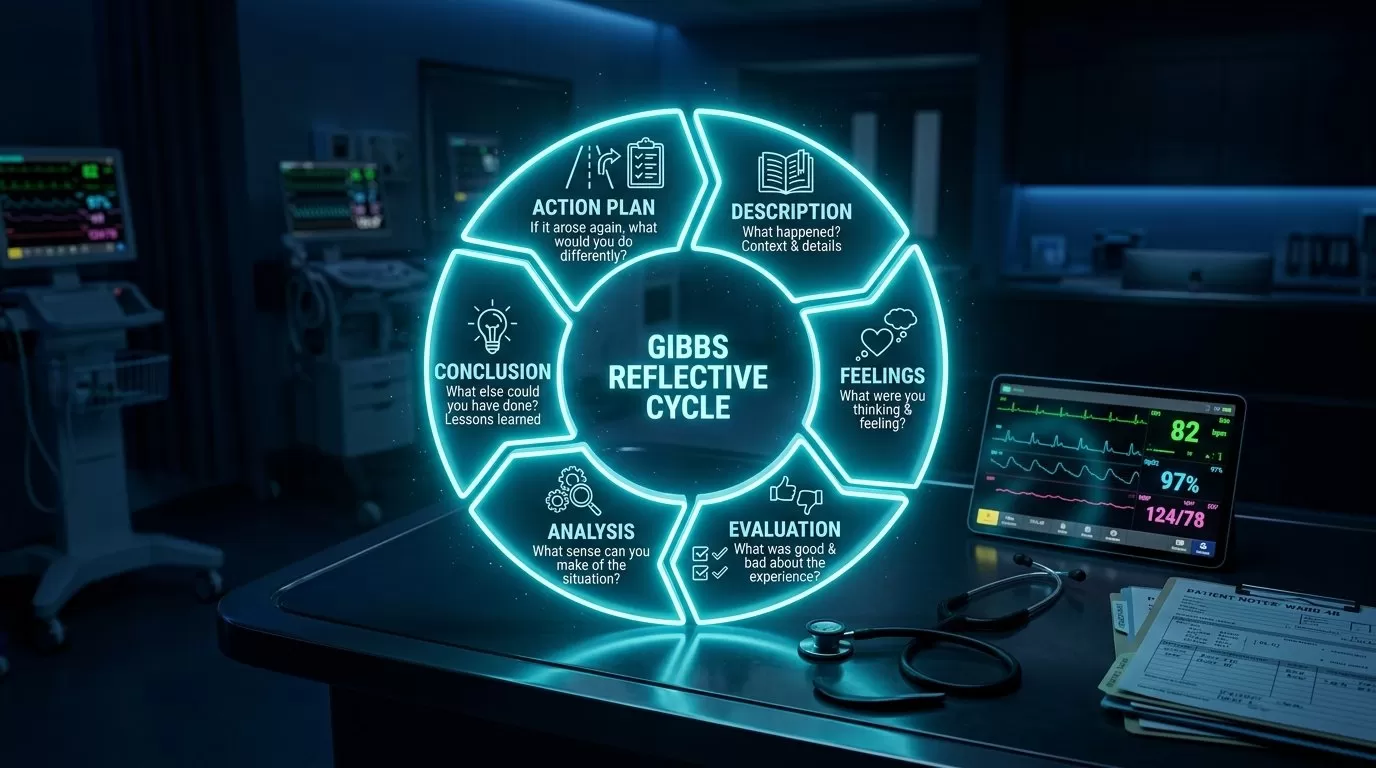
The Gibbs Reflective Cycle is an established, six-stage experiential learning framework introduced by Professor Graham Gibbs in 1988 to transform raw clinical and vocational experiences into rigorous, evidence-based learning. The cycle guides practitioners through six systematic phases: (1) Description, (2) Feelings, (3) Evaluation, (4) Critical Analysis, (5) Conclusion, and (6) Action Plan. In higher education healthcare programs, writing a distinction-grade reflective essay requires transcending descriptive storytelling by applying the 70/30 Critical Rule: reserving a maximum of 30% of the word count for narrative context and dedicating at least 70% to deep critical analysis, clinical rationales, human factors psychology, and peer-reviewed literature. Academic mentors at AssignPro Solution guide healthcare students globally in producing distinction-grade reflective coursework aligned with statutory standards across the UK (NMC), Australia (NMBA), Canada (CNO), and the United States (AACN).
Every academic term, thousands of nursing, healthcare, and higher-education scholars encounter one of the most deceptively challenging assignments in university education: writing an academic reflective essay using the Gibbs Reflective Cycle.
At first glance, reflective writing seems straightforward. Students are instructed to select a clinical shift incident, describe what occurred, recount their emotions, and identify lessons learned. However, university grading panels and external examiners consistently report that reflective coursework yields some of the highest resubmission rates in nursing and health sciences degrees:
Insufficient critical synthesis of contemporary peer-reviewed literature.
Action plan lacks concrete, measurable SMART objectives aligned with professional standards."
The core issue is that academic reflection is not an informal journal entry. In professional disciplines including the Bachelor of Science in Nursing (BSN), Master of Nursing Practice (MNP), Midwifery, Paramedicine, and Healthcare Administration, reflection is a formal regulatory competency governed by statutory councils such as the Nursing and Midwifery Council (NMC UK) and the Nursing and Midwifery Board of Australia (NMBA). It represents the crucial intellectual link connecting clinical practice, pathophysiological mechanisms, interprofessional communication, and patient safety.
This authoritative 2026 guide breaks down the full architectural methodology of the Gibbs Reflective Cycle. It examines each stage with specific academic prompt questions, resolves the grammatical balance between first-person introspection and third-person theoretical critique, presents a complete First-Class clinical case study model, and illustrates how postgraduate educators at Nursing Assignment Help Services mentor students to achieve 80%+ distinction marks.
Table of Contents
- What Is Gibbs Reflective Cycle? Theoretical Foundations and Academic Mandate
- Why Students Fail Reflective Essays: The Description Trap and The 70/30 Rule
- The 6 Stages of Gibbs Reflective Cycle: Step-by-Step Academic Breakdown
- Stage 1: Description (What Happened?)
- Stage 2: Feelings and Thoughts (What Were You Thinking and Feeling?)
- Stage 3: Evaluation (What Was Good and Bad About the Experience?)
- Stage 4: Critical Analysis (What Sense Can You Make of the Situation?)
- Stage 5: Conclusion (What Else Could You Have Done?)
- Stage 6: Action Plan (If It Arose Again, What Would You Do?)
- Academic Sentence Starters and Phrase Bank for Each Gibbs Stage
- First-Person vs. Third-Person Voice: The Academic Ratio
- The 6-Column Gibbs Reflective Coursework Matrix
- Complete Worked Distinction Case Study: Medication Near-Miss in an Acute Ward
- Comparing Reflective Frameworks: Gibbs vs. Johns vs. Schön vs. Borton
- Global Healthcare Standards: UK (NMC), Australia (NMBA), Canada (CNO) and USA (AACN)
- 7 Costly Mistakes Nursing Students Make in Gibbs Reflective Essays
- How AssignPro Solution Mentors Reflective Writing Scholars
- Frequently Asked Questions (FAQ)
- Step-by-Step Student Pre-Submission Audit Checklist
What Is Gibbs Reflective Cycle? Theoretical Foundations and Academic Mandate
The Gibbs Reflective Cycle was introduced in 1988 by American educational theorist Professor Graham Gibbs in his seminal publication Learning by Doing: A Guide to Teaching and Learning Methods. Gibbs constructed the model to operationalize the foundational experiential learning principles developed by David Kolb (1984).
While Kolb's four-stage cycle (Concrete Experience, Reflective Observation, Abstract Conceptualization, and Active Experimentation) established the cognitive foundations of experiential education, Gibbs identified that vocational and healthcare practitioners required a more structured, emotionally conscious, and iterative framework. Gibbs integrated affective evaluation directly into the learning cycle. In high-acuity environments such as clinical wards, intensive care units, and emergency departments, practitioners experience intense psychological stress responses. Cognitive psychologists note that unaddressed stress and emotional reactions directly influence clinical judgment and working memory (Kahneman, 2011; Damasio, 2005).
In modern university curricula and professional practice, the Gibbs Reflective Cycle fulfills four essential institutional and regulatory mandates:
- Transforming Tacit Knowledge into Explicit Competence: Clinical intuition is formed through repeated bedside exposure. Without structured reflection, unconscious competence remains unexamined. The Gibbs cycle forces practitioners to deconstruct intuitive actions, compare them against clinical guidelines, and validate their decisions through evidence-based practice (EBP).
- Mitigating Latent Human Factors and Medical Errors: Adverse events and medication near-misses in hospital wards rarely originate solely from individual incompetence. Instead, they stem from communication gaps, cognitive overload, and latent organizational failures (Reason's Swiss Cheese Model, 2016). Reflective writing provides the cognitive platform to conduct root-cause analysis on individual and systemic factors.
- Statutory Revalidation and Licensure Compliance: In the United Kingdom, the NMC Revalidation Policy requires every registered nurse and midwife to record five written reflective accounts referencing the NMC Code (2018) every three years. Similarly, the NMBA Continuing Professional Development Standard in Australia mandates documented reflective practice logs to ensure ongoing competency.
- Building Psychological Resilience and Reducing Compassion Fatigue: Clinical practice involves frequent moral dilemmas and patient distress. By acknowledging emotional responses in Stage 2 within a constructive problem-solving model, reflection helps practitioners mitigate burnout, secondary traumatic stress, and clinical anxiety.
Why Students Fail Reflective Essays: The Description Trap and The 70/30 Rule
Academic faculty across British, Australian, Canadian, and American universities frequently observe that up to 70% of reflective essay submissions score within the mediocre 50% to 58% pass threshold. The primary cause is what professors term The Narrative Description Trap.
Under pressure, students often allocate 1,000 to 1,400 words of a 2,000-word assignment to describing the physical sequence of events: what the patient said, how the room was laid out, and what each member of the healthcare team did. They provide a brief summary of their feelings, write a few sentences on what went well, and attach an unreferenced conclusion.
University grading rubrics award few marks for descriptive storytelling. Instead, high marks are awarded for critical evaluation, theoretical synthesis, and evidence-grounded action planning.
The 70/30 Academic Golden Rule for Reflective Coursework
To secure a First-Class (75% to 85%+) Distinction grade, your word count distribution must mirror the weight allocated in university assessment rubrics:
- 30% Maximum (Descriptive and Affective Context): Stage 1 (Description: 10% to 15%) and Stage 2 (Feelings: 10% to 15%). Concise, objective, authentic, and fully anonymized.
- 70% Minimum (Critical Scholarly Depth): Stage 3 (Evaluation: 15%), Stage 4 (Critical Analysis: 35%), Stage 5 (Conclusion: 10%), and Stage 6 (Action Plan: 10%). Synthesizes peer-reviewed literature, pathophysiological rationales, statutory codes, and concrete SMART development goals.
For students balancing clinical care planning alongside reflective coursework, our comprehensive guide on Nursing Assignment Help Services details how ADPIE documentation aligns directly with reflective analysis.
The 6 Stages of Gibbs Reflective Cycle: Step-by-Step Academic Breakdown
Mastering the Gibbs Reflective Cycle requires understanding the distinct analytical purpose, guiding prompt questions, and scholarly vocabulary for each of the six stages.

Figure 1: The six sequential stages of the Gibbs Reflective Cycle (1988), moving systematically from initial concrete experience to structured behavioral development.
Stage 1: Description (What Happened?)
The objective of Stage 1 is to provide a concise, factual, and chronological orientation of the clinical encounter. It establishes the context for the reader without unnecessary biographical detail.
Core Guiding Questions:
- Where and when did the encounter occur? What was the clinical setting (e.g., orthopedic surgical ward, emergency resuscitation bay, community care clinic)?
- Who was present (patient, family members, preceptor, multidisciplinary team members)?
- What was your assigned clinical responsibility and scope of practice?
- What were the significant actions and the immediate outcome?
Professional Anonymity and Regulatory Compliance: In accordance with the NMC Code (2018), NMBA Standards, and HIPAA regulations, you must protect patient confidentiality. Always state clearly: "To uphold professional confidentiality in accordance with NMC (2018) guidelines, pseudonyms are utilized, and all clinical dates, ward identifiers, and patient demographic indicators have been anonymized."
Stage 2: Feelings and Thoughts (What Were You Thinking and Feeling?)
Stage 2 shifts focus from external actions to internal cognitive and emotional responses. It requires genuine emotional introspection expressed in professional language.
Core Guiding Questions:
- What were your expectations and emotional state before the interaction commenced?
- What thoughts occurred during the critical juncture of the event? Did you experience apprehension, cognitive overload, confusion, or confidence?
- How did the verbal and non-verbal reactions of your mentor, colleagues, or patient impact your emotional composure?
- What were your feelings immediately after the event concluded, and how do you perceive the experience now?
Academic Tone Guidance: Frame emotional reactions within clinical competencies. For example, instead of writing "I felt scared," formulate the insight as: "I experienced significant apprehension regarding my pharmacological administration protocol, aware that an unverified calculation posed direct risks to patient safety."
Stage 3: Evaluation (What Was Good and Bad About the Experience?)
In Stage 3, you conduct an objective appraisal of the encounter, distinguishing elements that operated successfully from those that compromised care quality.
Core Guiding Questions:
- Which clinical actions were executed effectively according to standard operating procedures?
- Which interventions failed, were delayed, or fell short of professional standards?
- What was your personal contribution to both the positive outcomes and the procedural gaps?
- How did team dynamics, equipment availability, or environmental distractions influence the resolution?
Distinction Marker: Avoid simplistic binary evaluations. High-scoring essays capture clinical nuance: "Although the patient's acute respiratory distress was stabilized within acceptable parameters, our failure to assign a designated communications lead led to duplicated queries and heightened patient anxiety."
Stage 4: Critical Analysis (What Sense Can You Make of the Situation?)
Stage 4 is the intellectual centerpiece of your reflective essay, typically representing 35% to 45% of the total marking rubric. In this stage, you interrogate why the situation unfolded as it did by connecting empirical events to peer-reviewed research, pathophysiological mechanisms, human factors engineering, and clinical guidelines.
Core Guiding Questions:
- Why did specific interventions succeed while others failed? What physiological or systemic mechanisms drove the outcome?
- What does contemporary academic literature (published within the last 3 to 5 years) indicate about this clinical challenge?
- Which theoretical models (e.g., Reason's Swiss Cheese Model, SBAR communication tool, Tanner's Clinical Judgment Model) explain the encounter?
- Did cognitive heuristics (e.g., confirmation bias, anchoring bias, authority gradient) impair interprofessional collaboration?
- How did organizational stressors (staffing ratios, shift handover timing, alarm fatigue) intersect with practitioner decision-making?
| Encounter Dimension | Superficial Descriptive Remark (Pass Threshold: 50%) | Critical Scholarly Analysis (Distinction: 80%+) |
|---|---|---|
| Interprofessional Communication | "The doctor was dismissive because the surgical ward was busy with post-op admissions." | "The communication gap reflected the 'authority gradient' dynamic highlighted by Leonard et al. (2022), wherein junior clinicians defer challenging senior staff, undermining standardized SBAR escalation protocols." |
| Medication Administration Near-Miss | "I was hurried and nearly picked the wrong syringe because the packaging looked identical." | "The event illustrates Reason's (2016) Swiss Cheese Model of latent system failure, where Look-Alike Sound-Alike (LASA) packaging coincided with environmental alarm fatigue, bypassing the five rights of medication administration." |
| Clinical Deterioration Recognition | "The patient's condition worsened rapidly because their post-op infection spread during the night." | "The patient's deterioration into septic shock stemmed from unmonitored arterial lactate clearance delays, contrary to the Surviving Sepsis Campaign (Evans et al., 2021) and UK Sepsis Trust resuscitation bundles." |
Stage 5: Conclusion (What Else Could You Have Done?)
Stage 5 synthesizes the academic insights from Stage 4 into clear professional self-awareness. It establishes what alternative actions were clinically viable and identifies individual knowledge gaps.
Core Guiding Questions:
- Based on the literature reviewed in Stage 4, what alternative clinical pathways should have been executed?
- What specific clinical knowledge, procedural skills, or assertiveness competencies were lacking during the event?
- What steps would have prevented the adverse risk or optimized the therapeutic outcome?
- What overarching realizations have emerged regarding your ongoing professional identity?
Stage 6: Action Plan (If It Arose Again, What Would You Do?)
Stage 6 completes the cycle by transforming reflection into verifiable behavioral change. Gibbs noted that without a concrete action plan, experiential learning remains incomplete. Your plan must be formulated using the SMART framework (Specific, Measurable, Attainable, Relevant, Time-Bound).
Core Guiding Questions:
- If an identical clinical situation occurs during your next shift, what step-by-step actions will you take?
- What targeted clinical simulations, e-learning modules, or professional development programs will you complete?
- How will you evaluate your competency, and within what explicit timeline?
- How does this development plan align with your statutory regulatory standards (NMC, NMBA, CNO, AACN)?
Academic Sentence Starters and Phrase Bank for Each Gibbs Stage
To assist students in maintaining scholarly syntax throughout their reflective writing, use this curated phrase bank for each phase of the Gibbs Reflective Cycle:
Scholarly Sentence Starters Across the 6 Stages
Stage 1: Description
- "The clinical incident under examination occurred during my second-year placement in..."
- "In accordance with institutional guidelines, my designated scope of practice involved..."
- "The sequence of events commenced when bedside observations indicated..."
Stage 2: Feelings and Thoughts
- "Initially, I approached the procedure with confidence; however, the onset of unexpected complications prompted..."
- "I experienced notable cognitive conflict between adhering strictly to routine timing and addressing..."
- "Reflecting retrospectively upon the debrief, my initial frustration has transitioned into..."
Stage 3: Evaluation
- "An objective appraisal of the encounter demonstrates effective adherence to..."
- "Conversely, a critical shortcoming emerged in the delayed execution of..."
- "While the therapeutic outcome was achieved, the interpersonal communication process revealed..."
Stage 4: Critical Analysis
- "Interrogating this incident through Reason's (2016) Swiss Cheese Model indicates that latent organizational factors..."
- "This clinical breakdown corroborates empirical research by Westbrook et al. (2020), which demonstrates that ward interruptions..."
- "In accordance with NICE (2023) clinical guidelines, the pharmacological rationale for immediate intervention requires..."
Stage 5: Conclusion
- "Upon synthesizing the theoretical evidence, I recognize that my situational awareness was compromised by..."
- "A more proficient approach would have involved executing standardized SBAR escalation prior to..."
- "This encounter reinforces that patient safety relies on structured verification rather than informal assumption."
Stage 6: Action Plan
- "To address the clinical knowledge deficit identified, I will complete the certified e-learning module on..."
- "During future clinical placements, I will implement a non-negotiable bedside identification protocol requiring..."
- "This actionable objective directly aligns with NMC (2018) Standard 1 and NMBA (2020) Standard 3 requirements for..."
First-Person vs. Third-Person Voice: The Academic Ratio
A recurring source of confusion for university scholars is the grammatical voice: "Is the use of first-person ('I') permitted in academic writing, or will markers penalize subjective language?"
In standard scientific research reports and quantitative literature reviews, first-person pronouns are generally avoided. However, in reflective writing using the Gibbs Reflective Cycle, the first person is mandatory in specific sections and inappropriate in others.
The Academic Voice Matrix for Gibbs Reflective Writing
| Stage of Gibbs Cycle | Permitted Pronouns | Academic Register and Focus |
|---|---|---|
| Stage 1: Description | First Person ("I", "my") | Concise, professional narrative of observable actions and settings. |
| Stage 2: Feelings | First Person ("I felt", "I perceived") | Self-aware, honest appraisal of psychological and emotional states. |
| Stage 3: Evaluation | Mixed ("I identified", "The team") | Objective appraisal of positive achievements and procedural gaps. |
| Stage 4: Critical Analysis | Predominantly Third Person ("Studies demonstrate", "The guidelines state") | Formal academic literature synthesis, peer-reviewed citations, and theoretical frameworks. |
| Stage 5: Conclusion | First Person ("I conclude", "I realize") | Personal insights and realizations grounded in professional standards. |
| Stage 6: Action Plan | First Person ("I will complete", "My plan is") | Targeted, proactive, measurable SMART development commitments. |
The 6-Column Gibbs Reflective Coursework Matrix
When outlining a reflective assignment before drafting complete prose, university faculty recommend structuring your raw data in a tabular matrix to guarantee rubric alignment:
| 1. Description (10%) | 2. Feelings (10%) | 3. Evaluation (14%) | 4. Analysis (35%) | 5. Conclusion (10%) | 6. Action Plan (15%) |
|---|---|---|---|---|---|
| Factual Overview: - Clinical setting. - Role and scope. - Incident trigger. - Anonymized parties. |
Psychological State: - Initial confidence. - Acute stress during event. - Emotional aftermath. |
Dual Appraisal: - Effective competencies. - Flaws and oversights. - Outcome impact. |
Scholarly Literature: - Physiological basis. - Human factors concepts. - Clinical guidelines (NICE, WHO). - Ethical codes (NMC, NMBA). |
Personal Realizations: - What could be improved? - Unmet clinical proficiencies. |
SMART Goals: - Targeted simulation. - Communication modules. - Explicit timeline. |
If you need assistance analyzing your assignment brief and marking parameters, try our Free AI Assignment Brief Analyzer to map your rubric requirements before drafting.
Complete Worked Distinction Case Study: Medication Near-Miss in an Acute Ward
To demonstrate how distinction-grade standards are achieved in practice, examine this complete clinical case reflection. The vignette illustrates a second-year Bachelor of Science in Nursing student reflecting on a high-stakes clinical placement scenario.

Figure 2: Dissecting an acute medication administration near-miss through interprofessional communication and root-cause analysis.
Clinical Vignette: The Near-Miss Administration of Low-Molecular-Weight Heparin (LMWH)
Context: Acute Post-Surgical Orthopedic Ward 4B, 08:30 morning medication round.
Patient Profile: Mr. Davies, 71 years old, Day 1 post-total knee arthroplasty (TKA), prescribed Enoxaparin 40 mg subcutaneous injection for venous thromboembolism (VTE) prophylaxis. Concurrently, neighboring patient Mr. Davis (same bay, Bed 4) was prescribed subcutaneous Insulin Glargine.
Incident Summary: Under high ward workload and multiple concurrent call-bell alerts, the student nurse prepared Enoxaparin for Mr. Davies but was interrupted by a bed-exit alarm. Returning to the trolley, the student approached Mr. Davis (Bed 4) without executing bedside barcode scanning or two-identifier verbal verification. The preceptor intervened at the bedside, preventing an adverse drug event.
Stage 1: Description
During my second-year medical-surgical clinical placement on an acute post-orthopedic ward, I participated in the morning 08:30 medication administration round under the direct supervision of my registered nurse (RN) preceptor. We were caring for Mr. Davies, a 71-year-old post-operative patient prescribed subcutaneous Enoxaparin (40 mg) for venous thromboembolism (VTE) prophylaxis following a total knee arthroplasty. I selected the pre-filled Enoxaparin syringe from the clinical medication room and verified the drug, dose, and route against the Electronic Medication Administration Record (eMAR). Prior to entering the cubicle, an urgent bed-exit monitor alarmed in adjacent Bay 2. My preceptor stepped away to assist, instructing me to pause and wait. When she returned two minutes later, I took the medication tray and walked toward Bed 4, intending to administer the injection to Mr. Davis—a different patient with a diabetic regimen. My preceptor intervened immediately at the bedside, stating: "Stop and check the wristband; this is Mr. Davis, not Mr. Davies." No medication was administered, and the correct injection was subsequently given to Mr. Davies following three-way patient identification.
Stage 2: Feelings and Thoughts
Prior to starting the medication round, I felt prepared because I had demonstrated subcutaneous injection technique in university simulation laboratories. However, when the emergency alarm sounded and my mentor left the bay, I experienced immediate disorientation and perceived time-pressure, aware that four post-operative patients awaited morning rounds. When my preceptor intercepted my action at the bedside, my immediate emotional reaction was intense embarrassment, followed by severe anxiety and guilt. I visualized the clinical repercussions if Mr. Davis had received an unprescribed anticoagulant alongside his anti-platelet therapy. In the immediate aftermath, I felt inadequate and questioned my readiness for independent clinical practice. During a structured post-shift debrief with my clinical facilitator, my emotional response shifted from punitive self-blame to an objective commitment to understand the cognitive and environmental factors that contributed to the near-miss.
Stage 3: Evaluation
Evaluating this clinical encounter highlights both procedural strengths and significant safety vulnerabilities. Positively, the preceptor-student supervisory model operated as intended by professional regulatory bodies: double-checking and direct bedside oversight intercepted a medication error prior to patient harm (NMC, 2018; NMBA, 2020). Furthermore, I responded transparently to the near-miss: I engaged constructively in the debrief, avoided defensive justification, and participated in documenting the event in the hospital's Datix clinical incident reporting system. Negatively, I breached standard medication administration safety protocols. I permitted environmental disruption to break the continuous chain of medication preparation and delivery. Most critically, I neglected two-point active patient identification (requesting full name and date of birth while verifying the wristband against the eMAR) before entering the patient's bedside space with an uncapped syringe.
Stage 4: Critical Analysis
Critically analyzing this near-miss requires examining the intersection of cognitive psychology, human factors engineering, and hospital systems. In healthcare environments, medication administration errors are rarely isolated individual lapses; they represent systemic vulnerabilities conceptualized by James Reason's (2016) Swiss Cheese Model of System Accidents. Multiple latent systemic holes aligned in this scenario: high ward acuity, morning shift cognitive fatigue, Look-Alike Sound-Alike (LASA) patient names in the same four-bed bay (Mr. Davies versus Mr. Davis), and an audible alarm distraction.
Empirical literature indicates that environmental interruptions represent the primary trigger for medication errors. A multi-center observational study by Westbrook et al. (2020) demonstrated that each interruption during a medication administration round increases the risk of procedural failure by 12.7% and doubles the risk of clinical harm. When the bed-exit alarm sounded, my working memory was disrupted. Cognitive psychologists identify this as prospective memory failure—the brain loses its place in an automated sequence, prompting the clinician to resume at a subsequent, incorrect step without verifying prior stages (Drews et al., 2021).
Furthermore, this encounter highlighted the critical importance of the Rights of Medication Administration (Right Patient, Right Drug, Right Dose, Right Route, Right Time, Right Documentation, and Right Reason) endorsed by the World Health Organization (WHO, 2022) Global Patient Safety Challenge: Medication Without Harm. I fell into confirmation bias: having verified the medication vial in the treatment room, I assumed the physical patient in Bed 4 corresponded to the chart in my hand without executing electronic barcode scanning. Administering Enoxaparin to a patient with surgical bleeding contraindications could have induced unmonitored hemorrhaging (NICE, 2023).
Stage 5: Conclusion
In conclusion, this clinical encounter provided an essential lesson in clinical vigilance and patient safety systems. I recognized that while my psychomotor injection technique was sound, my situational awareness and resilience against environmental distractions were deficient. Patient safety cannot rely on good intentions; it depends on non-negotiable adherence to standardized safety checks—regardless of ward busyness or supervisory presence. In hindsight, I should have stopped, re-verified the eMAR upon my preceptor's return, and maintained a "sterile cockpit" mindset where no medication moves between bays without bedside electronic verification.
Stage 6: Action Plan
To ensure this procedural lapse is never repeated in my clinical career, I have formulated the following SMART professional development action plan aligned with NMC (2018) Standard 1 and NMBA (2020) Standard 3:
- Immediate (Within 7 Days): Complete the certified NHS Health Education England e-Learning for Healthcare module on Safe Medication Administration and Human Factors in Patient Safety, scoring at least 90% on the summative assessment.
- Medium-Term (Current Placement): Institute a personal "Zero-Interruption Protocol." If interrupted during medication preparation, I will restart the five rights from step one. I will execute verbal bedside identification using the phrase: "Could you please state your full name and date of birth while I verify your wristband?" for 100% of administrations.
- Long-Term (Prior to Qualification): Complete interprofessional high-fidelity simulation training on crisis resource management (CRM) and SBAR escalation, focusing on managing clinical distractions under acute workload stress.
Comparing Reflective Frameworks: Gibbs vs. Johns vs. Schön vs. Borton
While the Gibbs Reflective Cycle is the most widely assigned reflective model, university professors often require students to justify their choice against alternative frameworks:
| Reflective Framework | Structural Stages | Primary Academic Strengths | Key Limitations |
|---|---|---|---|
| Gibbs Reflective Cycle (1988) | 6 Stages: Description, Feelings, Evaluation, Analysis, Conclusion, Action Plan. | Balances affective introspection, critical analysis, and actionable behavioral modification. Ideal for clinical coursework. | Requires discipline to prevent descriptive word count creep in Stage 1. |
| Schön's Model (1983) | 2 Phases: Reflection-in-Action vs. Reflection-on-Action. | Captures dynamic real-time intuition, split-second decision-making, and practitioner adaptations under emergency conditions. | Lacks a prescriptive, step-by-step structure; harder to format into an undergraduate essay. |
| Johns' Model for Structured Reflection (2000) | Guided cues across 5 areas: Aesthetics, Personal, Ethics, Empirics, Reflexivity. | Deeply philosophical; exceptional for complex ethical dilemmas, palliative care, and internal moral conflict. | Complex and time-consuming; can become overly theoretical for routine clinical skill evaluation. |
| Borton's Framework (1970) | 3 Core Questions: "What?", "So What?", "Now What?" (Rolfe et al., 2001). | Simple, rapid, and intuitive. Superb for daily bedside handovers and short reflection logs. | Too minimalist for comprehensive 2,500-word university essays requiring multi-theoretical synthesis. |
Global Healthcare Standards: UK (NMC), Australia (NMBA), Canada (CNO) and USA (AACN)
Depending on your university's national jurisdiction, assessment criteria align with specific statutory codes:

Figure 3: Achieving a First-Class 80%+ grade requires aligning reflective introspection with national statutory codes and Turnitin-audited human authorship.
1. United Kingdom: NMC Code (2018) and The Four Pillars
In British institutions, reflective essays must map directly to the four pillars of The NMC Code (2018): Prioritise people, Practise effectively, Preserve safety, and Promote professionalism and trust. Coursework must demonstrate how reflection satisfies revalidation requirements under the UK Academic Guidelines.
2. Australia: NMBA Registered Nurse Standards for Practice (2020)
Australian nursing faculties (e.g., USYD, Monash, Deakin, UTS) evaluate reflective essays against the NMBA Registered Nurse Standards. Submissions must demonstrate Standard 1 (Thinks critically and analyses nursing practice) and Standard 3 (Maintains the capability for practice), linking care to cultural safety protocols through our Australia Academic Support.
3. Canada: College of Nurses of Ontario (CNO) and Provincial Competencies
Canadian healthcare programs evaluate reflective self-assessment within provincial Quality Assurance (QA) standards. Coursework emphasizes therapeutic nurse-client boundaries, ethical accountability, and evidence-informed decision-making via our Canada Academic Advisory.
4. United States: AACN Essentials and NCSBN Clinical Judgment
American BSN and MSN curricula assess reflective writing using the AACN Essentials Core Competencies. Reflective essays must reflect the NCSBN Clinical Judgment Measurement Model (CJMM): recognizing cues, analyzing hypotheses, generating solutions, taking action, and evaluating outcomes.
7 Costly Mistakes Nursing Students Make in Gibbs Reflective Essays
Academic evaluation committees consistently highlight seven recurring pitfalls that limit student scores:
- Over-Describing and Under-Analyzing: Spending 60% or more of the word count on narrative detail rather than clinical analysis (violating the 70/30 Rule).
- Omitting Academic Citations in Stage 4: Treating Stage 4 as personal conjecture instead of grounding every observation in contemporary (2021 to 2026) peer-reviewed research, Cochrane reviews, or national guidelines (NICE, WHO, CDC). Format references using our Free AI Reference Generator.
- Superficial Emotional Introspection: Writing either a dry clinical chart note without genuine self-awareness, or an undisciplined emotional venting session that lacks professional perspective.
- Breaching Confidentiality and Institutional Anonymity: Naming mentors, wards, hospital trusts, or specific patient identifiers, triggering academic misconduct penalties.
- Vague Action Plans in Stage 6: Writing generic resolutions such as "Next time, I will pay more attention." High marks require SMART objectives with verifiable CPD modules and timelines.
- Confusing Reflective Writing with Medical Diagnosis: Framing the essay around medical pathophysiology rather than examining clinical reasoning, communication dynamics, and professional accountability.
- Using Raw Generative AI Output: Copy-pasting text from automated AI generators. AI models hallucinate non-existent citations, invent fake DOIs, and produce recognizable syntax patterns that trigger Turnitin AI detection alerts.
How AssignPro Solution Mentors Reflective Writing Scholars
Juggling 12-hour hospital shifts, objective structured clinical examinations (OSCEs), pharmacology assessments, and 3,000-word reflective essays can lead to severe academic exhaustion.
At AssignPro Solution, we provide bespoke academic mentoring and model reference coursework tailored for university healthcare and professional scholars:
- Verified Postgraduate Healthcare Specialists: Your reflective coursework is mentored by practicing registered nurses, clinical nurse educators, or Master's and PhD scholars who understand hospital ward realities and exact university marking rubrics across the UK, Australia, the US, and Canada.
- 100% Original, Zero-AI Human Authorship: In an academic landscape filled with automated content and fabricated references, our scholars draft every paper through authentic clinical judgment. We provide comprehensive Turnitin reports confirming 0% AI detection. Learn more through our Essay Writing Help Services.
- Authentic Peer-Reviewed Citations: Every clinical rationale is substantiated by published healthcare literature from the last 3 to 5 years, formatted in APA 7th, Harvard, Vancouver, or Chicago referencing.
- Rapid Turnaround Mentoring: Facing an urgent submission deadline? Our rapid-response academic faculty delivers distinction-standard model coursework in as little as 12 to 24 hours via our Request Academic Guidance Portal.
Frequently Asked Questions (FAQ)
1. What are the 6 stages of the Gibbs Reflective Cycle in order?
The six stages of Graham Gibbs' Reflective Cycle (1988) in chronological order are: (1) Description (What happened?), (2) Feelings (What were you thinking and feeling?), (3) Evaluation (What was good and bad about the experience?), (4) Analysis (What sense can you make of the situation using theory and evidence?), (5) Conclusion (What else could you have done?), and (6) Action Plan (If it arose again, what specific SMART steps will you execute?).
2. Can you use first-person "I" in a Gibbs reflective essay?
Yes. Reflective writing is an introspective process, so writing in the first person ("I observed," "I felt," "My reflection") is expected in Stage 1 (Description), Stage 2 (Feelings), Stage 3 (Evaluation), Stage 5 (Conclusion), and Stage 6 (Action Plan). However, in Stage 4 (Analysis), you must transition into formal, third-person academic discourse when citing peer-reviewed studies, pathophysiological concepts, and clinical guidelines.
3. How do you reference literature in a Gibbs reflective essay?
Integrate scholarly citations primarily within Stage 4 (Critical Analysis) and Stage 6 (Action Plan). For instance, when analyzing a communication breakdown, do not simply describe the dialogue; substantiate your observations using recognized communication models (e.g., SBAR, ISBAR) and research on cognitive workload (e.g., Westbrook et al., 2020; Reason's Swiss Cheese Model) formatted in your institution's required citation style.
4. What is the difference between Gibbs and Kolb's reflective models?
David Kolb's (1984) Experiential Learning Cycle contains four broad cognitive phases: Concrete Experience, Reflective Observation, Abstract Conceptualization, and Active Experimentation. Graham Gibbs (1988) expanded Kolb's model into six distinct stages, explicitly introducing Feelings into the analytical process and separating pragmatic Evaluation from theoretical Analysis, making it practical for clinical and vocational disciplines.
5. Why do university markers penalize students for being "too descriptive"?
University grading rubrics allocate up to 70% of marks to critical analysis, theoretical synthesis, and evidence-grounded action planning. When students dedicate 70% of their word count to detailing chronological events in Stage 1, they leave insufficient space to demonstrate clinical reasoning and scholarly research, capping their grades in the 50% to 58% range.
6. Can I use AI like ChatGPT to write my Gibbs reflective essay?
Using raw generative AI for reflective essays is hazardous. Generative AI tools lack genuine clinical lived experience, frequently fabricate non-existent journal DOIs, and generate recognizable linguistic cadence that triggers Turnitin AI detection alerts, creating serious academic integrity risks.
7. How can AssignPro Solution assist with my Gibbs reflective essay assignment?
AssignPro Solution connects you with qualified Master's and PhD healthcare scholars who structure your clinical reflection using the 70/30 rule, synthesize peer-reviewed literature, and deliver a 100% human-crafted, Turnitin-verified model solution tailored to your university grading rubric.
Step-by-Step Student Pre-Submission Audit Checklist
Before submitting your reflective essay assignment, perform this final quality audit:
Final Gibbs Reflective Essay Self-Assessment Checklist:
- [PASS] Confidentiality Verified: Are all patient, mentor, hospital, and ward identifiers completely anonymized in accordance with NMC, NMBA, and HIPAA guidelines?
- [PASS] 70/30 Rule Maintained: Is narrative description strictly capped at 30% of total words, with at least 70% dedicated to evaluation, analysis, and action planning?
- [PASS] Emotional Depth in Stage 2: Did you explore authentic internal thoughts and reactions rather than just summarizing external events?
- [PASS] Evidence-Based Synthesis in Stage 4: Is every critical observation supported by contemporary (last 3 to 5 years) peer-reviewed literature or clinical guidelines?
- [PASS] Grammatical Voice Shift: Did you use first-person ("I") for personal reflection and third-person for theoretical literature synthesis?
- [PASS] SMART Action Plan in Stage 6: Does your future action plan include specific, measurable, achievable, relevant, and time-bound CPD objectives?
- [PASS] Zero AI and Originality: Has your assignment been verified for 100% human authorship and Turnitin compliance?